3 Ideas to Build a Cohesive Team: Case Study

Do you know what prevents your team from being effective and productive?

How to find time in your busy schedule and dedicate to your team conversations?

And the most important of all, as a leader, why should you care?

I will try to answer all these 3 questions by describing a real case scenario and give you some practical Tools that you can use with your teams. There are so many techniques that Systemic Team Coaching offers for your team to convert it from regular to extraordinary. But let´s start from the beginning.

So where to start when you feel that your teams needs a boost to continue giving their best?

Lets take a real example, the team I am currently working with and which consist of 4 people. Let´s call them ¨Team A¨.

Their initial request and objective for the Team Coaching was: to convert our team to more cohesive and productive (pretty much a standard request I get from majority of the team leaders).

The very first thing which I did is to establish the Coaching Alliance which is a basis of each relationship. This is so important because you want to make sure you as a leader work WITH your team, that means that you establish common grounds and everyone participates in the creation of this Alliance where you cover such questions as:

-What spirit do you want to create while working together?

-What do you need from me as a leader?

-What will help us (as a team) to rich our highest potential?

Seems very basic but it is a basis of every professional relationship. This will empower you, as a leader and your team to create common grounds that you will be happy to work on (Resource 1). And this is when you discover what prevents your team from being effective and productive, when each one is able to share what they need from you, as a leader and a group (as promised, hopefully I answered your first question).

Once we did this, I send to the Team A the survey where I asked them to individually score their sense of productivity, team spirit and purpose. After presenting the results of the survey, the leader of the Team A shared that ¨they failed¨ in several areas of this survey. In short, this survey revealed that the purpose of the team, their productivity and their sense of team spirit were quite low. Does that seem familiar to your team as well?

So what I offered them is to work and complete very useful exercise, which is often forgotten but has a direct impact on teams values, roles definition, needs and expectations. This is called Team Canvas (Resource 2). Use it for every team in order to plant a small seed of the importance of the collective results. Result for the Team A? They came up with an ¨out of the box idea¨ to block their agendas for several hours to work on the topics that matter. (Answering to the second question, your people are the priority and finding time for topics that matter makes your team better, quicker and is building confidence with you, as a leader).

We continued with the sessions and each time they kept raising their voice during our meetings and had that feeling of not really listening to each other. Have it as well in your Team? So in this case, I offered them to work on 4 types of toxic communication and question the root cause of it (Resource 3). The results were amazing because the Team A became aware of their toxic communication and came out with another idea how to tackle it – every time they perceive or transmit any toxic communication pattern, they will raise a hand and make another team member aware of it. The way your team members treat each other directly affects their motivation to belong to this team and hence, work in your company and be creative (and this is my answer to the third question, why should you care).

Let´s remember Henry Ford´s words: Coming together is a beginning; keeping together is progress; working together is success.

The question is – are you really committed for success?

Please find the link for the free resources that I have described above:

https://cutt.ly/wj7PGkA

And if you need any additional resource or advise, just get in touch with me!
Effective Leadership: Empowering Teams and Organizations

What does it mean to be a good leader?

How can leaders empower their teams during uncertain times?

What are 5 key actions to boost your company culture in challenging times?

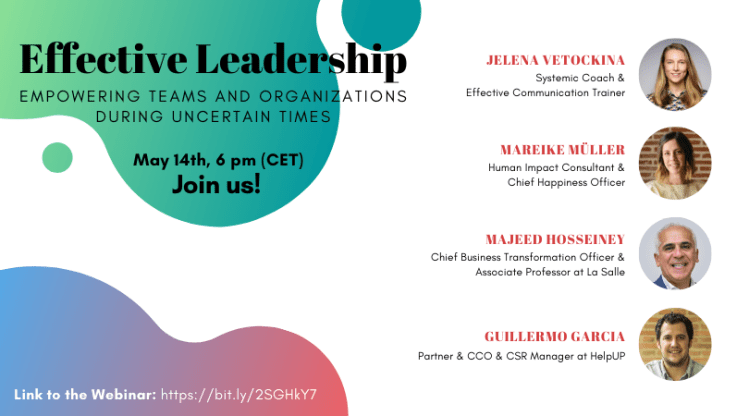
During our last online Webinar we were discussing the above questions with 3 amazing speakers, human impact and business transformation leaders who were sharing their ideas on the effective leadership.

While no one can predict with confidence what will happen next, it is likely that uncertainty will generate volatility for some time to come. I think it is important to note that leaders and others in management positions have no immunity from feelings of helplessness and anxiety fostered by these events. And that’s why the main goal of our online webinar was to support leaders and managers, so they are better equipped in times of uncertainty and are able to show the way forward to their employees and instill a sense  of energy and inspiration that their organizations need.

Majeed Hosseiney shared his expertise on leadership and mentioned that the most powerful tool for leading is to use the ¨emorational¨ approach. This means that as leaders we are not just focusing on the rational side of the leadership (planning, reviewing, approving the budget, etc.), but even more important is that we use our emotional intelligence to connect with people and our teams. ¨Good leader is always on the back stage, since it’s not about him or her, but about their people¨ – says Majeed.

What is the most challenging for you as a manager while leading in uncertain times?

Another important ingredient of any leadership is to be able to connect with your team, to show a way forward and to empower them.

How?

I shared another technique that leaders can use in order to empower their teams. And this is about focusing on the team strengths. It is important for leaders to know their team strengths, to discuss them openly and to use them during challenging times. And the first thing you might want to do is to plan to discuss your team strengths in your next team meeting. One of the easiest way to do this is to start with the following exercise:

  • create a questionnaire that would reveal your team strengths, asking each member of your team to complete it individually
  • create a nurturing environment to have an open discussion with your team, where each of the members can share their outcomes on this exercise

I always advise for the managers and leaders to be creative with their own questionnaire and to adapt it to their companies needs.

However below are some questions that you might consider to include in your team strengths questionnaire:

1. What activities and skills are core to your day-to-day work?

2. Among the skills you previously listed, which are you most proud of? Why?

3. For which skills you are seen a go-to resource, or “expert” by your peers?

4. Which skills or activities that you listed do you feel least confident about?

This exercise has several advantages: first, it allows team members to work on their self-awareness about where they stand in terms of their strengths and the needed skills.  Second, it gives visibility to leaders on the current needs of their team and creates an idea on how can team strengths be used in challenging times.  

What about the importance of the company culture?

Mareike Müller shared 5 key actions to boost company culture in challenging times, which are the following:

  1. Vertical recognition. It is crucial for the leaders to recognize their team efforts and especially those teams that were the most affected during challenging times.
  2. Horizontal recognition. This is peer to peer recognition and leaders can even promote it by offering rewards.
  3. Online team buildings in order to re-focus on the core company values.
  4. Implement several surveys on the satisfaction and well-being at work and act on it after analyzing the answers.
  5. Do fun things! You can be creative and do some fun videos and share with the whole company (especially applicable in order to include a social element while working remotely).

The entire recording of this online discussion is available in my YouTube Channel, you will find it by clicking the following link: https://bit.ly/2AwiDrd

We invite you to become a part of this important conversation on personal and organizational well-being!

Stay well and safe,

Jelena


This article uses material from Become Your Inspiration.

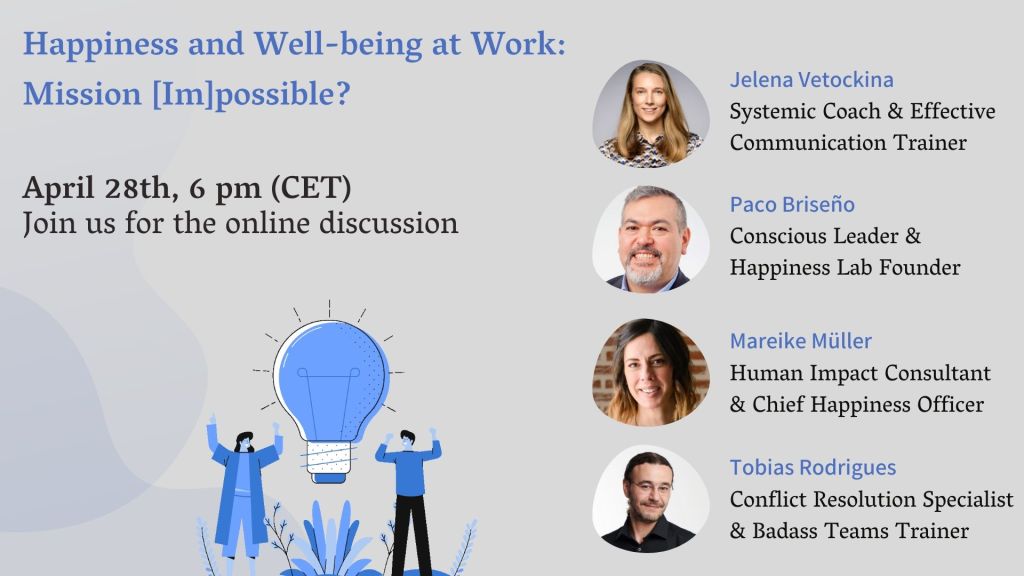
Happiness and Well-being at Work

This week I had an honor to lead the online discussion with several human impact leaders and conflict resolution experts, during which we shared our ideas and practices on personal happiness and well-being at work.

We started our discussion by mentioning the concept which was introduced by the scientists of the University of California at Berkeley. In their research on happiness at work they have revealed the concept PERK which can lead us towards a greater well-being and productivity at work. Each letter of this acronym stands for the essential pillar that needs to be in place in order for the individual to experience well-being at work. PERK stands for:

P – Purpose

– Engagement

– Resilience

K – Kindness

So let’s start uncovering these essential pillars that will lead us to a greater well-being at work.

How can we find our purpose at work?

As Paco Briseño explains, one of the important measures of well-being at work is to feel a sense of a purpose. Ideally our personal values are connected with organizational values which we are working for. Having purpose is to feel that we have a positive impact on our community and other people’s lives, by adding value with our work. Does that happening to you at work? And if not, I invite you to start uncovering your own values, searching for your ”Ikigai”, this is a Japanese ancient concept according to which you can find your purpose by asking yourself the following questions:

-What do I love doing?

-What am I good at?

-What can I be paid for?

-What does the world need?

The repetitive pattern that you will find in each four areas of your answers for the above questions, will be your Ikigai.

How can we check with ourselves whether we are engaged at work and how can we elevate our engagement?

As Mareike Müller mentioned, our starting point will be to check with ourselves, whether we generally enjoy our work? Do we have an autonomy to complete our assigned projects? How often do we feel immersed in tasks and have a sense of losing track of time?

Once you have your answers to the above questions, you might wonder how to elevate your engagement? The easiest way is to check what are the possibilities for you to have projects that are challenging (but still achievable), where you can work at your strengths and where you have autonomy to decide how you will complete the assigned project. Give it a thought and see who can help you with your new projects assignations that are more appealing to you.

These questions are the starting point to help you to take the ownership for your happiness and well-being at work. This will give you an idea what can be done at your current workplace in order to feel purpose and engagement at work or will confirm your previous intentions to change your job.

What are the best practices to stay resilient?

Tobias Rodrigues invites us to think of resilience as an emotional fitness. There are 3 areas that we need to take care of in order to become emotionally fit: body, mind, relations.

Body – we should be giving ourselves enough time of sleep (from 7-9 hours).

Mind – it is important to use our mind in our favor, one simple way is to practice gratitude. Going back into present or past moments of our life and finding what do we want to be grateful for.

Relationships – one simple way is to be playful, laughing, calling and encouraging people, celebrating – positive emotions prepare us to be able to take challenges and bounce back.

And finally, how can we practice kindness?

This means to which extent we treat ourselves and others with respect and dignity, are we a good listeners and able to provide constructive feedback? Another essential ingredient – being able to show compassion to ourselves and to others. Practicing kindness in your workplaces will transform it to a better and healthier place.

Another important aspect that we were mentioning during our discussion is the role of leaders in organizations and their impact on their teams.

So the following question arise:

How can leaders help their teams to become the most effective during the uncertain times?

Mareike Müller explained the concept of MAGIC. This abbreviation comes from the book “MAGIC: 5 Keys to Unlock the Power of Employee Engagement”, but Mareike shared her interpretion:

MEANING: create purposeful work and tasks – use positive reinforcement without punishing mistakes.

AUTONOMY: give your people control and responsibility for their work – no micro-managing.

GROWTH: support further education and provide career plans including personal growth as well.

IMPACT: lead through inspiration, emotional intelligence and by example, eliminate threads and punishment.

CONNECTION: listen, listen, listen and take time to get to know your people – be a person of trust and commit to your people.

You can view the entire recording of this online discussion in my YouTube Channel, by clicking the following link: https://bit.ly/3aSIxC3

We invite you to become a part of this important conversation on personal and organizational well-being!

Happy to receive your comments and suggestions on our next online talk!

Stay well and safe,

Jelena


This article uses material from Become Your Inspiration.

Increasing Emotional Well-being In Uncertain Times

If you are reading this post that means that you consciously have chosen to develop your emotional well-being, maybe to increase it or you might have decided to take a new look at the uncertain situation the entire world is living in this moment.

Whatever your reason is, I want to congratulate you on the commitment you are making with yourself and with society, by elevating your energy and conscious response to the situation and by choosing to practice the below exercise I am bringing to you today.

First of all, let’s start building our awareness as to how do we usually manage changes or uncertain situations in our life?

As part of the “mental map” exercise, please write the first ten words that you associate with the word “uncertainty”. Allow the words to flow without thinking too hard. There is no right or wrong answer.

We continue this exercise with the following questions – allow yourself some time to answer the below:

-What is challenging for me when navigating uncertainty?

-What is the strength that I bring when navigating change?

-What would help me to navigate change better?

Once you have your answers to the above questions, let’s continue with the next part of the exercise, which is – taking responsibility for our well-being.

To continue with the exercise, please list all those things that you currently worry about and that may distract you from being present. These may also include past or future events.

It is important to note here, that it’s quite normal to worry and feel concerned about certain situations or events. However what is really dangerous for our mental health is getting trapped in a constant state of concern or anxiety, that blocks us from moving forward.

The below question is the one that can actually help us to unblock this unconscious state of concern and allow us to move forward:

-Can I actually do something about this?

To continue with the exercise, look at the list of your worries you created previously and separate those things or thoughts that you feel you can actually do something about it. Those are the thoughts/worries that are in your zone of control.

Once you identified those thoughts or worries that you can do something about it, please write down at least 1 action for each thought/worry and think how you will become accountable for it.

Lastly, check with yourself the following:

-What is your commitment with the actions you have identified earlier?

-When you will start? How you will do it?

Create a small action plan that will help you to become accountable for your well-being, taking small steps each day you will make a big difference.

By now you should have your list of worrying thoughts and some of them you have converted into actions and real commitments with yourself or with others.

And what about the things and worrying thoughts that are outside of our zone of control?

What can we do with those?

From my own experience that helped me and clients I worked with, below are 3 practices you might find useful:

First – acceptance. Accept that there is nothing you can do about it and it is outside of your zone of control. Some practices that might help you are meditation, yoga, physical activity (these are some practices that train your brain to focus on the present moment).

Second – gratitude. Be grateful for the small (or big!) things, people, situations you have. You can start your gratitude with people that you care about or even with things that you have (food, hot water, place to stay, etc. – all those things we are taking for granted usually).

Third – support. Become available for your closer community, support them with whatever you can, put your own grain of sand for the society or your closer circle. Once we start supporting others we connect with our precious inner world, hopefully making someone’s life a little bit better.

There is a quote I would like to share with you that I’ve heard from my friend which I find it very suitable for our current state of mind:

“Life has no rehearsal, enjoy every minute of it”.

And my final question to you is the following:

-What attitude do you choose while living in times of uncertainty?

Now more than anything,

wishing you all to stay well!

Jelena


This article uses material from Become your inspiration.